
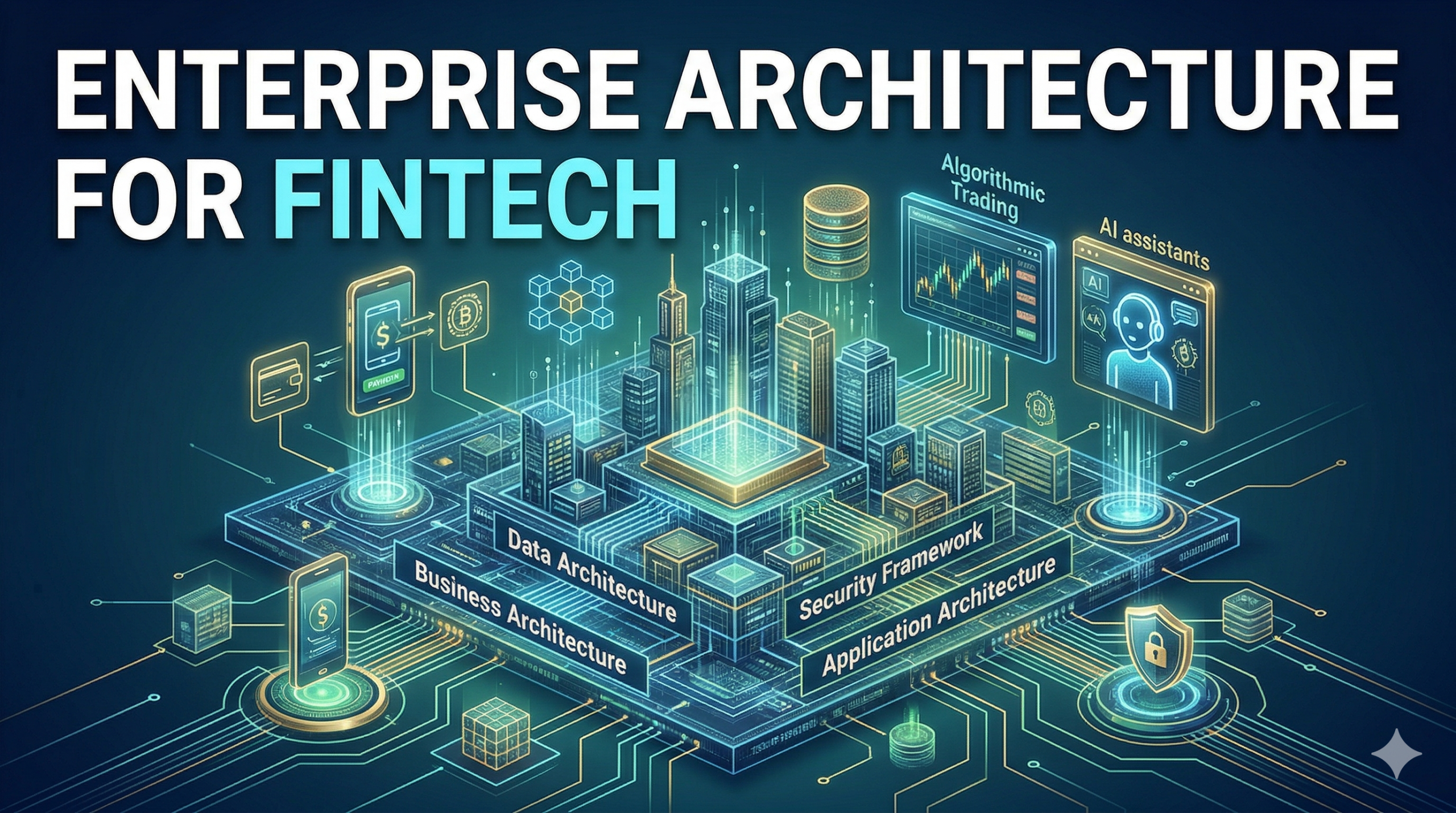
When most engineers hear the word “architecture,” they think of boxes and arrows on a whiteboard. When I hear it as a fintech CTO, I think of risk, regulation, scalability, and trust, all at once. Enterprise Architecture (EA) is the discipline that brings those concerns together into a coherent blueprint for how a business and its technology should work in harmony.
What Is Enterprise Architecture?
Enterprise Architecture is a practice for analysing, designing, planning, and implementing the analysis and execution of strategy within an organisation. It provides a structured framework for aligning business goals with IT capabilities. In fintech, where business models evolve rapidly and regulatory requirements shift constantly, EA is not a luxury , it is a survival mechanism.
The most widely adopted EA framework is TOGAF, The Open Group Architecture Framework. TOGAF provides the Architecture Development Method (ADM), a step-by-step process for developing and maintaining enterprise architectures. It covers four architecture domains: Business, Data, Application, and Technology (commonly referred to as BDAT).
Why Fintech Needs Enterprise Architecture
Fintech organisations operate at the intersection of financial services and technology. This creates a unique set of architectural challenges that generic IT frameworks don’t always address well. Here are the key reasons why EA matters deeply in this space:
Regulatory Compliance by Design: Regulators like the Monetary Authority of Singapore (MAS) require financial institutions to demonstrate control over their technology landscapes. TOGAF’s architecture governance capabilities help map controls directly to compliance obligations, making audits and regulatory submissions significantly less painful.
Managing Technical Debt at Scale: Without an architectural blueprint, fintech startups accumulate technical debt at an alarming rate. EA provides the guardrails to make informed trade-off decisions such as when to build, buy, or integrate, while keeping the long-term architecture coherent.
Interoperability and Integration: Fintech products rarely operate in isolation. They connect to banks, payment gateways, KYC providers, and regulatory reporting systems. EA defines integration patterns and data standards that prevent fragmentation as the ecosystem grows.
Speed Without Chaos: Startups move fast, but speed without structure leads to brittle systems. EA frameworks allow organisations to define architecture principles that teams can move fast within, rather than against.
Applying TOGAF ADM in a Fintech Context
The TOGAF ADM is a cyclic, iterative process. While the full ADM has ten phases, in a fintech startup context I typically focus on a pragmatic subset:
Phase A — Architecture Vision: Define the scope, stakeholders, and the high-level target architecture. In fintech, this means identifying the core product capabilities — payments processing, identity verification, ledger management — and mapping them to business outcomes like regulatory compliance or customer acquisition.
Phase B — Business Architecture: Document the business processes, organisational structures, and information flows. For a digital payments platform, this includes onboarding flows, transaction lifecycles, settlement processes, and dispute management.
Phase C — Information Systems Architecture: Define the data and application architectures. Which data entities exist? How do they flow between services? What applications are owned internally vs. sourced from third parties? This phase often reveals where duplication and gaps exist in the data model.
Phase D — Technology Architecture: Map the infrastructure, platforms, and deployment patterns. This is where cloud strategy, containerisation, API gateway design, and observability tooling get defined and standardised.
Architecture Principles That Guide Fintech Decisions
Architecture principles are the foundation of any mature EA practice. They act as decision-making guardrails that persist across projects and team changes. In my experience leading fintech engineering teams, I have found the following principles to be non-negotiable:
API-First Design: All capabilities must be exposed as APIs before building a UI on top of them. This enforces loose coupling, enables external integrations, and future-proofs the product.
Security by Default: Security controls are not bolted on after development, they are embedded in every architectural decision, from data encryption at rest and in transit to zero-trust network access patterns.
Compliance Traceability: Every data flow must be traceable to a compliance requirement. This is critical for MAS-regulated environments where you need to demonstrate data lineage, access controls, and audit trails.
Design for Failure: Assume every third-party dependency will fail. Build circuit breakers, retry logic, and fallback mechanisms into the architecture from day one. In payments, a failed transaction that is not handled gracefully can mean real financial loss.
Operational Observability: You cannot manage what you cannot see. Every service must emit structured logs, metrics, and traces that feed into a centralised monitoring platform. This is not optional for fintech as it is a regulatory expectation.
Common Pitfalls in Fintech Enterprise Architecture
After working across multiple fintech organisations, I have observed recurring architectural mistakes that slow teams down and create significant risk:
Architecture as a One-Time Exercise: EA is not a document you write once and shelve. It must be a living practice, revisited with every major product decision, infrastructure change, or regulatory update.
Ignoring Data Architecture: Many fintech teams focus heavily on application architecture while neglecting data. This leads to inconsistent data models across services, making analytics, compliance reporting, and AI/ML initiatives extremely difficult to execute.
Treating TOGAF as a Bureaucracy: TOGAF is often perceived as heavyweight. The antidote is pragmatic adoption, use the ADM as a thinking tool, not a documentation treadmill. Tailor it to your organisation’s maturity and pace.
Siloed Architecture Teams: Enterprise architects who sit in ivory towers, disconnected from engineering squads, produce architecture that no one follows. The most effective EAs I have worked with are embedded within product teams, shaping decisions in real time.
Final Thoughts
Enterprise Architecture is not about producing beautiful diagrams, it is about making better decisions faster, with the full picture in view. In fintech, where the cost of a wrong architectural decision can manifest as a regulatory breach, a security incident, or a system outage, having a coherent EA practice is one of the most valuable investments a CTO can make.
TOGAF gives us a proven vocabulary and methodology to structure that thinking. The key is to apply it with pragmatism, use what fits, adapt what doesn’t, and always keep the business outcome at the centre of every architectural decision.
If you are a CTO, VP of Engineering, or enterprise architect working in financial services and would like to exchange notes on this, feel free to connect with me on LinkedIn. I am always open to conversations about architecture, fintech, and technology leadership.